
Uncategorized
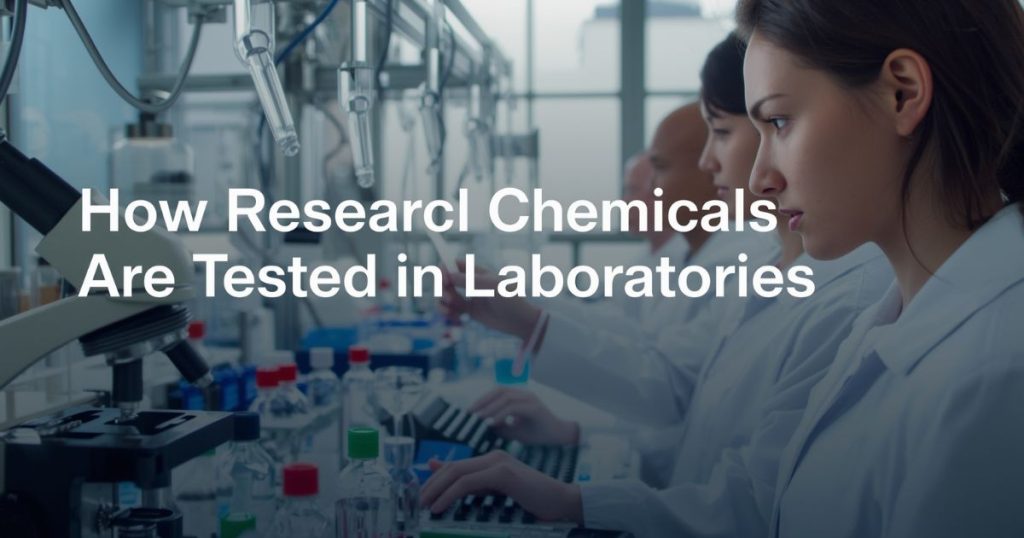
How Research Chemicals Are Tested in Labs (Step-by-Step)
Apr
As the demand for research chemicals continues to grow in 2026, ensuring accuracy, purity, and consistency has become a critical priority for laboratories and researchers. Unlike standard commercial products, research chemicals must undergo rigorous testing and validation before they can be considered reliable for scientific use.
Even small impurities or structural inconsistencies can lead to incorrect data, failed experiments, or misleading results. That’s why laboratories follow strict analytical procedures to confirm a compound’s identity, purity, composition, and stability.
Modern testing relies on advanced techniques from analytical chemistry, allowing scientists to verify whether a chemical meets research-grade standards. These processes are also documented in quality reports such as the Certificate of Analysis (COA), which serves as proof of verification.
👉 In this guide, you’ll learn how research chemicals are tested step by step, what methods are used, and how these tests ensure safe, accurate, and reproducible results.
What Laboratory Testing Aims to Confirm
Before a research chemical is approved for use, laboratories must confirm:
- Chemical identity (Is it the correct compound?)
- Purity level (How much of it is the target substance?)
- Impurity profile (Are there contaminants present?)
- Stability (Will it remain consistent over time?)
These factors determine whether a chemical is suitable for research applications.
Step-by-Step Process of Research Chemicals Are Tested
Step 1: Sample Preparation
The process begins with preparing the chemical sample:
- Dissolving the compound in a suitable solvent
- Filtering impurities
- Standardizing concentration
👉 Proper preparation ensures accurate testing results.
Step 2: Identity Confirmation
Labs verify that the substance is the correct compound using:
- Mass Spectrometry (MS) → confirms molecular weight
- Nuclear Magnetic Resonance (NMR) → identifies molecular structure
👉 This step ensures the chemical is exactly what it claims to be.
Step 3: Purity Analysis
Purity is measured using:
- High-Performance Liquid Chromatography (HPLC)
- Gas Chromatography (GC)
These methods separate compounds and calculate the percentage of the target substance.
Step 4: Impurity Detection
Labs identify unwanted substances such as:
- Residual solvents
- By-products
- Contaminants
👉 Even small impurities can affect research accuracy.
Step 5: Quantitative Analysis
This step determines:
- Exact concentration
- Chemical composition ratios
👉 Ensures the chemical meets expected specifications.
Step 6: Stability Testing
The chemical is tested under different conditions:
- Temperature changes
- Light exposure
- Storage environments
👉 This confirms whether the compound remains stable over time.
Step 7: Documentation (COA Generation)
All results are compiled into a Certificate of Analysis (COA), which includes:
- Purity data
- Testing methods
- Batch information
- Lab verification
👉 This document serves as proof of quality and compliance.
Common Laboratory Testing Methods
| Method | Purpose |
| HPLC | Measures purity |
| GC | Separates volatile compounds |
| MS | Confirms molecular identity |
| NMR | Analyzes molecular structure |
Why Laboratory Testing is Essential
Without proper testing:
- Chemical identity cannot be confirmed
- Purity levels remain unknown
- Research results become unreliable
With proper testing:
- Data becomes accurate and reproducible
- Experiments remain consistent
- Compliance standards are maintained
Example of Tested Research Chemical Supply
Best Research Chemicals
- Provides lab-tested compounds with COA verification
- Uses advanced analytical methods for quality control
- Maintains consistent batch testing standards
- Ensures transparent documentation for each product
👉 Suitable for researchers who require verified and reproducible chemical quality
Common Testing Misconceptions
“Purity alone is enough”
→ Identity and impurities also matter
“All suppliers test chemicals the same way”
→ Testing quality varies significantly
“COA guarantees perfection”
→ It reflects test results, not absolute perfection
Related Guides
👉 Learn more:
Frequently Asked Questions
How are research chemicals tested in laboratories?
They are tested using methods like HPLC, GC, MS, and NMR to verify identity, purity, and composition.
What is the most important test?
Purity analysis (HPLC/GC) is critical, but identity confirmation is equally important.
Why is testing necessary?
It ensures the chemical is accurate, safe, and suitable for research use.
What document proves testing?
The Certificate of Analysis (COA) provides verified lab results.
Key Takeaways
- Laboratory testing verifies identity, purity, and stability
- Multiple analytical methods are used for accuracy
- COA documents the entire testing process
- Proper testing ensures reliable research outcomes
Without lab testing, research chemicals cannot be trusted for scientific use.
